

Sariska Tiger Reserve – how to reach, best time, safari bookings, zones to prioritise, stay options, tiger-spotting tips, clothing tips.
Looking for a weekend getaway from Delhi or Gurgaon — one that mixes wilderness, wildlife, and a shot at spotting India’s majestic big cat — but without the crowds and hype of big resorts? Sariska Tiger Reserve could be exactly what you need. Nestled in the Aravalli hills of Alwar district (Rajasthan), Sariska offers a rugged, authentic jungle experience — with tigers, deer, birds, and rustic landscapes. This guide will walk you through how to plan, book, and enjoy Sariska smartly.
🐯 Location & how to reach — perfect for a quick wildlife weekend
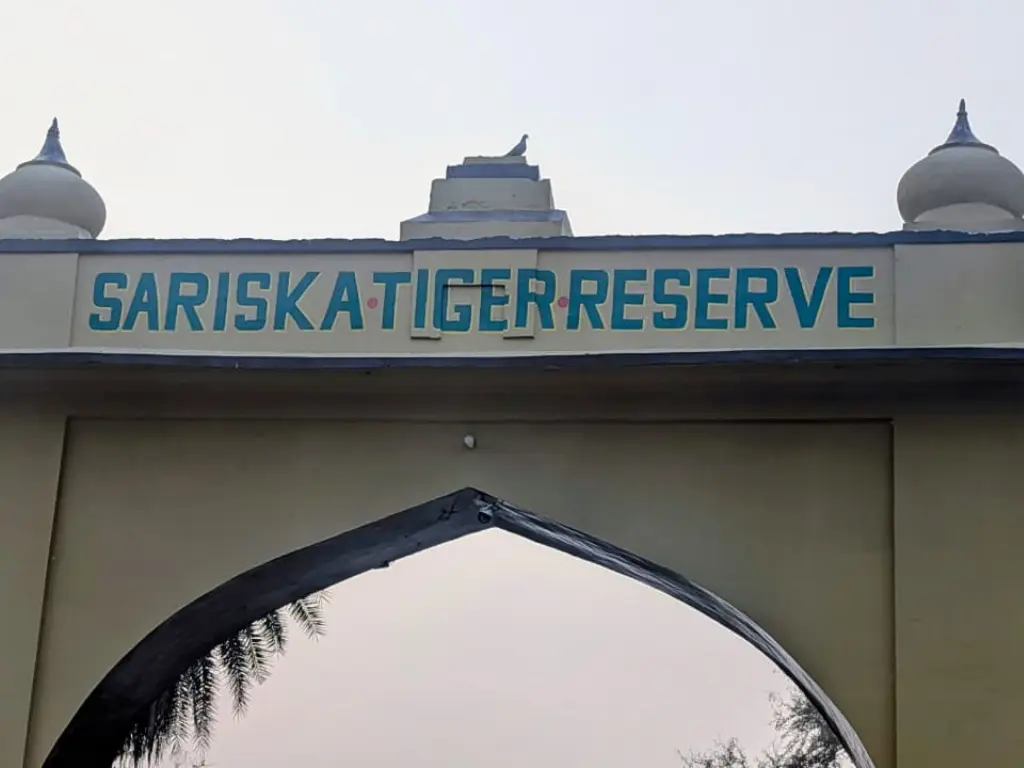
Sariska Tiger Reserve is located in the Alwar district of Rajasthan, within the ancient hills of the Aravalli Range.
- It is roughly about 200 km from Delhi (making it a manageable ~4-5 hour drive depending on traffic and time of day).
- Delhi → Sariska: ~200 km (4.5–5 hrs)
- Gurgaon → Sariska: ~160 km (3.5–4 hrs)
- Jaipur → Sariska: ~110 km (3 hrs)
- Alwar → Sariska: ~40 km (1 hr)
Because of this proximity, Sariska is a great option for a weekend getaway from Delhi / Gurgaon / NCR / Jaipur — perfect if you want a taste of wild without a long journey.
🕰 Best Time to Visit Sariska
The experience of Sariska changes with every season, but the ideal time to visit is from November to April, when the weather is pleasant and visibility in the forest is at its best. These cooler months not only make the safaris more comfortable but also offer higher chances of spotting tigers and other wildlife as animals move around more freely. If you’re sensitive to heat, it’s best to avoid May and June, when temperatures can be extreme. The monsoon months (July to September) are also not ideal, as many zones remain closed for forest regeneration. Visiting in the right season truly elevates the Sariska experience.
History: From hunting grounds → extinction → revival
Sariska has a long history: earlier, these forests were part of the princely state of Alwar and served as a hunting ground. After India’s independence, the forests came under government protection.
- In 1955, the region was notified as a wildlife reserve; in 1978 it became an official tiger reserve under Project Tiger.
- In 1982, the protected forest was declared a national park (core area).
- Sadly, by 2004–2005, owing to rampant poaching (and other pressures), all tigers in Sariska were declared missing — no sightings, no pug-marks, nothing.
- To revive the habitat, tigers from Ranthambore were relocated: in 2008 and 2009, several tigers (males and females) were introduced into Sariska — marking India’s successful tiger-reintroduction project.
- Over the years, with protection, monitoring, and natural breeding, Sariska slowly recovered its tiger population.
- As per recent reports (2025), the tiger population in Sariska has reached 50 individuals, after new cubs were recorded.
Today Sariska stands as a strong example of conservation success: from zero tigers to a growing stable population again.
Tiger population & Reserve size (core & buffer zones)
- The total area of Sariska Tiger Reserve is often cited as around ~866–881 sq km (depending on classification).
- The “core”/critical tiger habitat (where tigers mostly roam) is large — and there’s also a “buffer/peripheral” zone around it.
- Having around 50 tigers in under ~900–1,000 sq km (with good prey base and habitat) means reasonable chances of sightings — especially if you know where to go and when.
Zones: Core vs Buffer — where to hope for tiger spotting
- The reserve is divided into core (critical tiger habitat) + buffer/peripheral zones.
- The “core” zone — often more remote, protected, and less disturbed — is where tigers and major wildlife prefer. For best tiger-spotting chances, core areas or zones closer to core should be prioritized. There are Zone 1, Zone 2 and Zone 3 in the core area.
- That said, sometimes tigers — especially young ones — may roam into buffer areas, especially near water sources or prey-rich zones. There are Zone 4 and Zone 5 in the Buffer area.
- Zone 1, Zone 2 and Zone 3 (main entry gate — “Sariska Gate”) are widely considered best for tiger / wildlife sightings (tigers, leopards, deer, birds, etc.).
- Zone 4 and Zone 5 (accessible via alternate gate — “Tehla Gate”) are also popular among naturalists and tourists, and is often recommended as a less-crowded core-zones. However, these are generally less frequented for tiger sightings compared to core zones 1 or 3 and are considered lower probability zones for big-cat spotting.
Tip — if tiger sighting is your main goal — prioritise safari bookings in Zone 1 or Zone 3 (core area). Zone 2 is also okay but slightly less “famous.” Buffer zones or Zone 4 are more for scenery, birds, or if core-zones are full.
Tips for Tiger Spotting at Sariska
- Go early (dawn) or late afternoon — Tigers are most active during low-light hours.
- Be quiet, stay alert, and follow your guide’s instructions — Minimal noise and sudden movements help.
- Look near waterholes, valleys, and grasslands — Tigers hunt or rest near water / prey-rich zones.
- Be patient — don’t expect a guaranteed sighting. Even with 50 tigers, wildlife is unpredictable.
- Use binoculars / zoom lenses — Many sightings may be distant or partially hidden.
- Follow safari-time regulations, and don’t venture off-track — Straying can disturb habitat or scare wildlife.
🦌 Not Just Tigers — Wildlife You Can Spot in Sariska
While Sariska is gaining popularity again because of its growing tiger population, the reserve is actually rich in many other species — making it a rewarding safari even if the big cat decides to stay hidden that day.
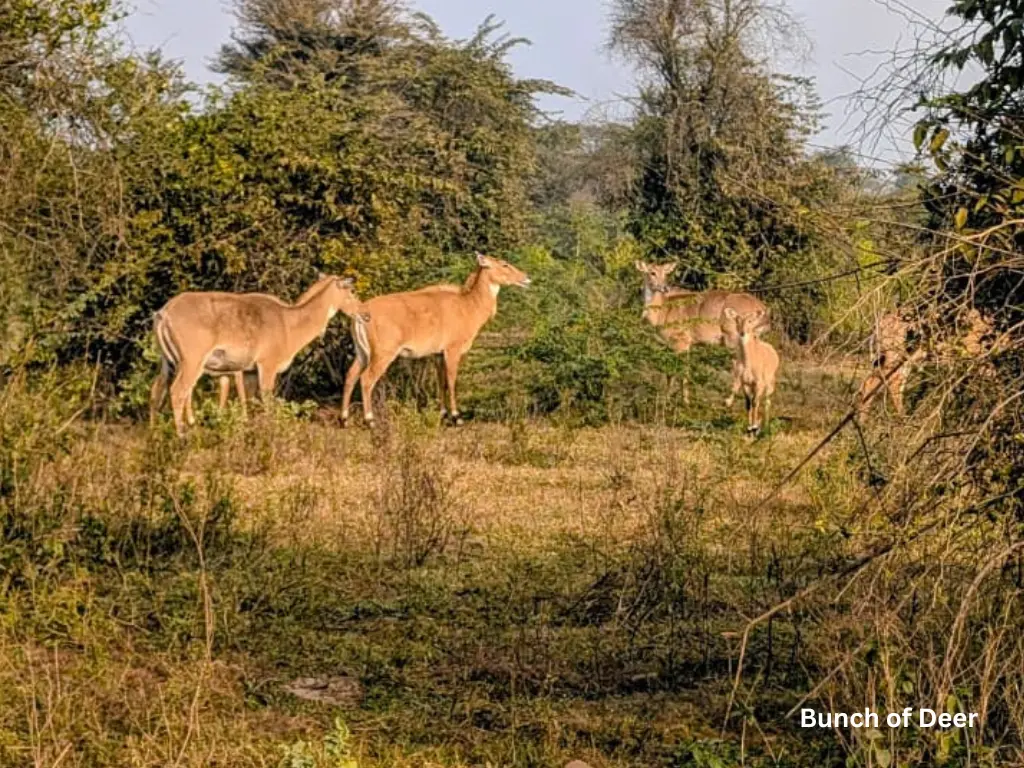
Here’s what you can expect to see:
- Spotted Deer (Chital): Large herds grazing in open forest patches.
- Sambar Deer: The biggest deer species in India; often found near water bodies or deep forest trails.
- Nilgai (Blue Bull): Commonly seen around grasslands or rocky clearings.
- Peacocks: Sariska is full of them — you’ll spot dozens during any safari.
- Wild Boar, Langurs & Macaques: Frequently seen near safari tracks.
- Birdlife:
- Grey francolin
- Parakeets
- Eagles & owls
- Indian roller
- Woodpeckers
- Kingfishers
- And many migratory species in winter
- If you enjoy bird photography, Sariska is surprisingly rewarding — the mix of valleys, cliffs, and open woodland makes it easy to spot birds in action.
What to wear & bring on Safari
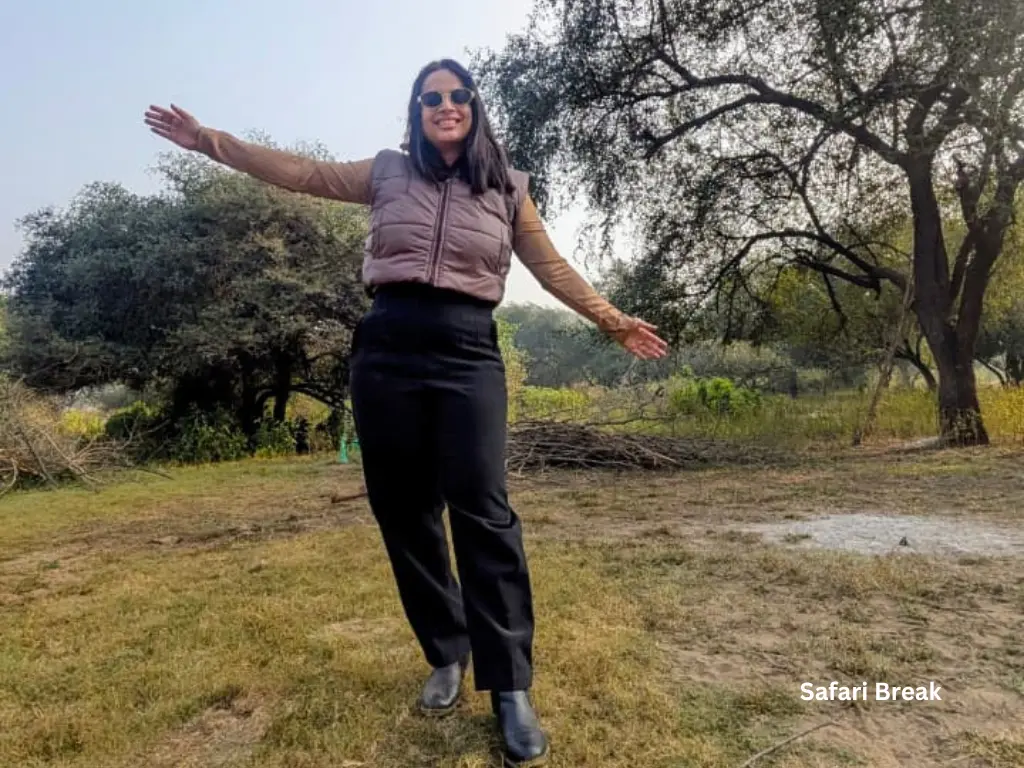
- Neutral-coloured clothes (khaki, olive, brown) — avoid bright colours that can spook animals.
- Lightweight, breathable fabrics (cotton / moisture-wicking): summers can be hot, winters chilly.
- Comfortable closed shoes — forest tracks may be dusty, rocky or muddy.
- A hat / cap, sunglasses, sunscreen — for sun exposure.
- Binoculars / camera with zoom lens, and a small backpack for water, snacks, essential items.
- Light jacket / windbreaker if you go early morning or in winter (nights can get cool).
- Carry a bottle of water but avoid littering in the forest area.
🎟️ Booking Process & Costs for Safari
- Safaris at Sariska typically run via jeeps or “canters” (group safari vehicles) — private vehicles are normally not allowed inside the core tiger-habitat.
- You can book safari online via the official safari-booking platform for Sariska Tiger Reserve; Sariska safari online (government portal). Book early — seats fill quickly, especially weekends/peak season.
- Safari permits are issued on a first-come, first-served basis.
- Typical costs (2025-26 rates) are:
- Jeep / Gypsy Safari (sharing seat): ~ ₹1,300 per Indian tourist. Jeep / Gypsy (open jeep): Seats fewer (up to 6) — more flexible, better for photography and off-track viewing (within rules).
- Canter Safari (sharing seat): ~ ₹900 per Indian tourist. Canter (open-top bus): Seats large groups (e.g., 18–20). Cheaper per person, good for budget travellers and birders.
- For full-jeep booking (if travelling as a small group or alone) costs will be higher; some private-jeep options (via certain agencies or booking portals) quote higher full-vehicle prices.
- Post Booking you will recieve a booking ticket and you have to show the ticket along with the ID proof at the entry gate on the day of your safari to get a boarding pass along with guide and jeep/canter; so reach early on the day of safari.
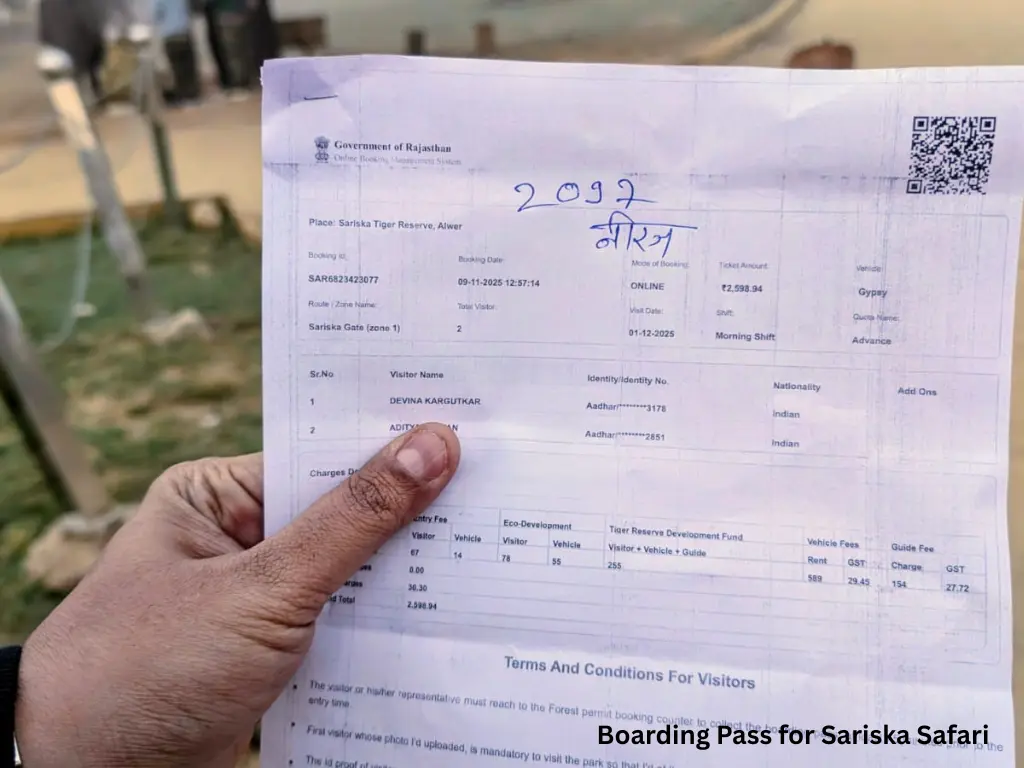
- Safari durations are typically 3–3.5 hours, and there are two slots — morning and evening (exact times vary by season).
- Cost & booking details change depending on season, number of people, and whether you choose a shared canter or private jeep — always check with the official booking portal or forest-department site.
- Booking advice: Book well in advance (especially on weekends / peak season) — shared seats fill up quickly. Always carry valid photo ID (as required by forest dept on safari day).
- Tip for guides: Engage a good, experienced forest-dept certified guide — they know tiger-patterns, watering holes, animal trails. Respect their instructions, keep noise low, and avoid flash photography or sudden movement. A respectful, calm tourist increases your odds of a sighting.
Stay Options — Stay Near Safari Entry / Core Zone
Because roads inside and around Sariska (especially near the reserve) may not always be in great shape — it’s advisable to stay as close to the safari entry / reserve as possible rather than distant hotels.
Staying near the park reduces long travel time early morning (when safari starts), helps you catch dawn safaris, and also ensures you can easily follow schedule in case of early-morning or late-afternoon safaris. Examples (range of styles):
Luxury / resort: Sterling ReWild Sariska (or similar). We stayed here and the experience was authentic and amazing. It is 10 kms from the main entry gate and has a comfortable stay with great food.
Boutique / safari camps: Utsav Camp Sariska, Sariska Safari Lodge, Kasba – A Village Resort (check current availability & reviews).
If you plan longer stay or want a bit of city + heritage + comfort — stay in Alwar:
Alwar is only about ~ 35- 40 km or so from the reserve.
🐅 My Personal Experience in Sariska
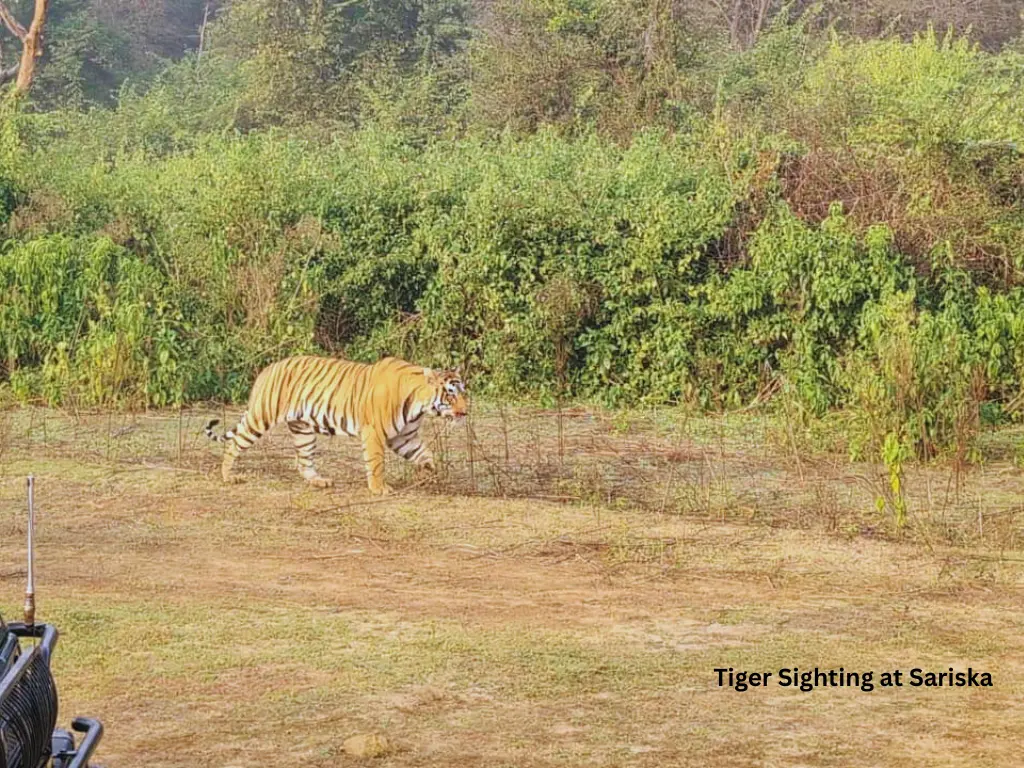
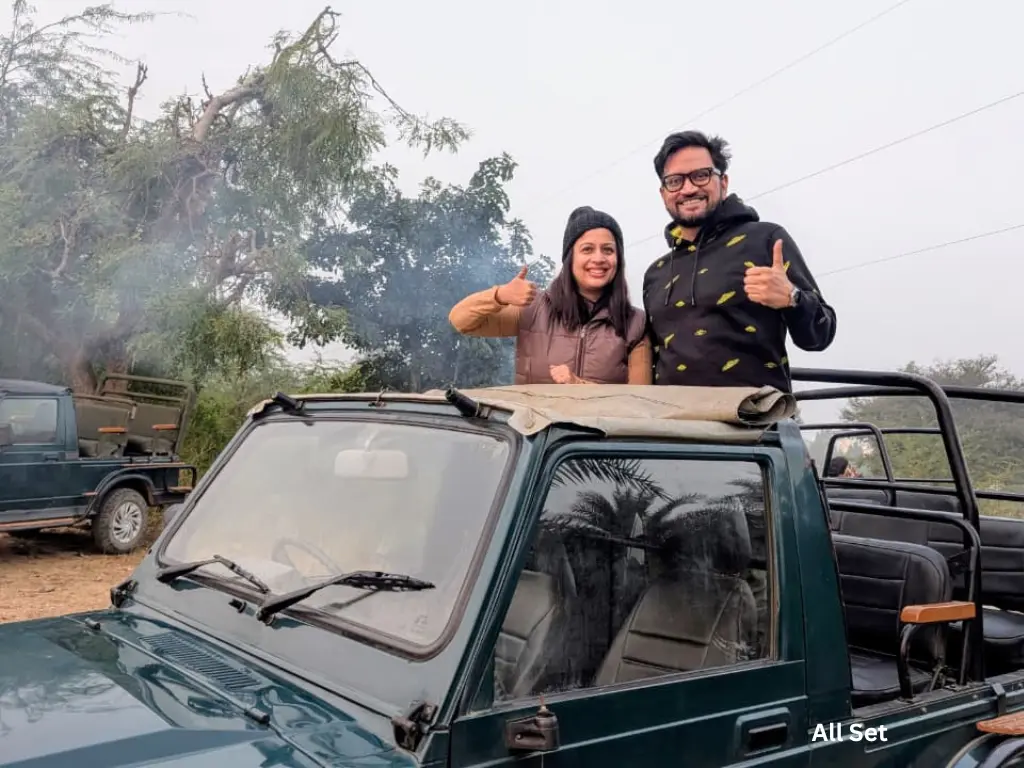
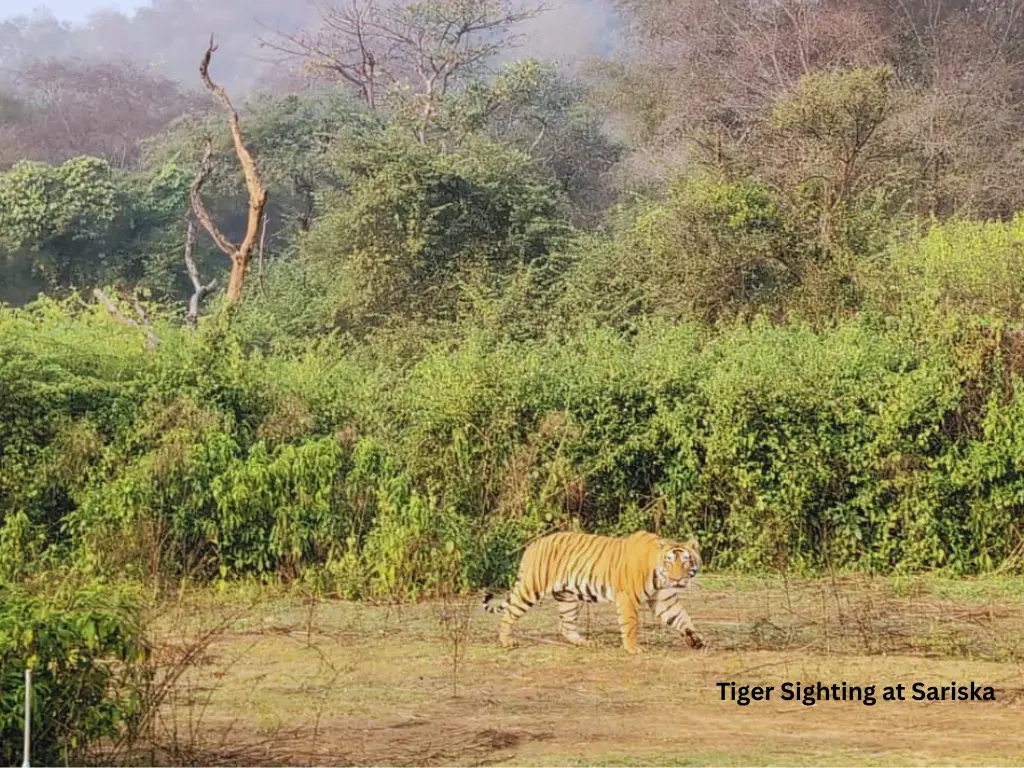
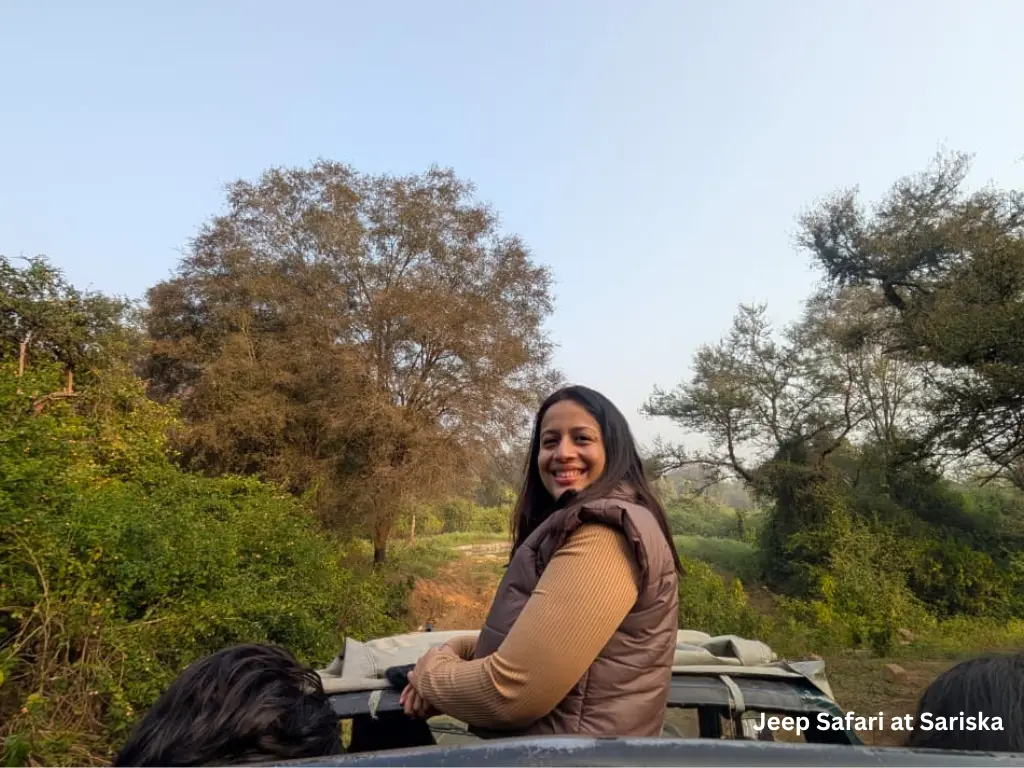
Our early-morning safari in Zone 1 turned into one of the most unforgettable wildlife moments of my life. Just a few minutes after entering the forest, we spotted a young tiger—around 2.5 years old—but already huge and incredibly powerful. Several jeeps had gathered around as he walked confidently along the track, completely unfazed by the attention. Watching him so closely, in the soft golden morning light, felt surreal—one of those rare safari moments you don’t forget.
The rest of the jungle was equally alive. We spotted spotted deer, a majestic nilgai, a crocodile resting near a waterbody, and a variety of beautiful birds that filled the forest with their calls. Sariska may be quieter and less hyped than Ranthambore, but experiences like this remind you why it’s such a special, under-rated gem.

Why Sariska is worth considering — “Big cat spotting without the crowd”
- It offers a rare blend of rugged wild forest + accessibility — just a few hours from Delhi / NCR, yet a world away in atmosphere.
- The relatively lower tourist-footfall compared to mega-reserves means less disturbance, more wildlife authenticity.
- Thanks to its recent successful conservation and reintroduction efforts, the growing tiger population (≈ 50 now) and healthy prey base make real tiger-sighting possible.
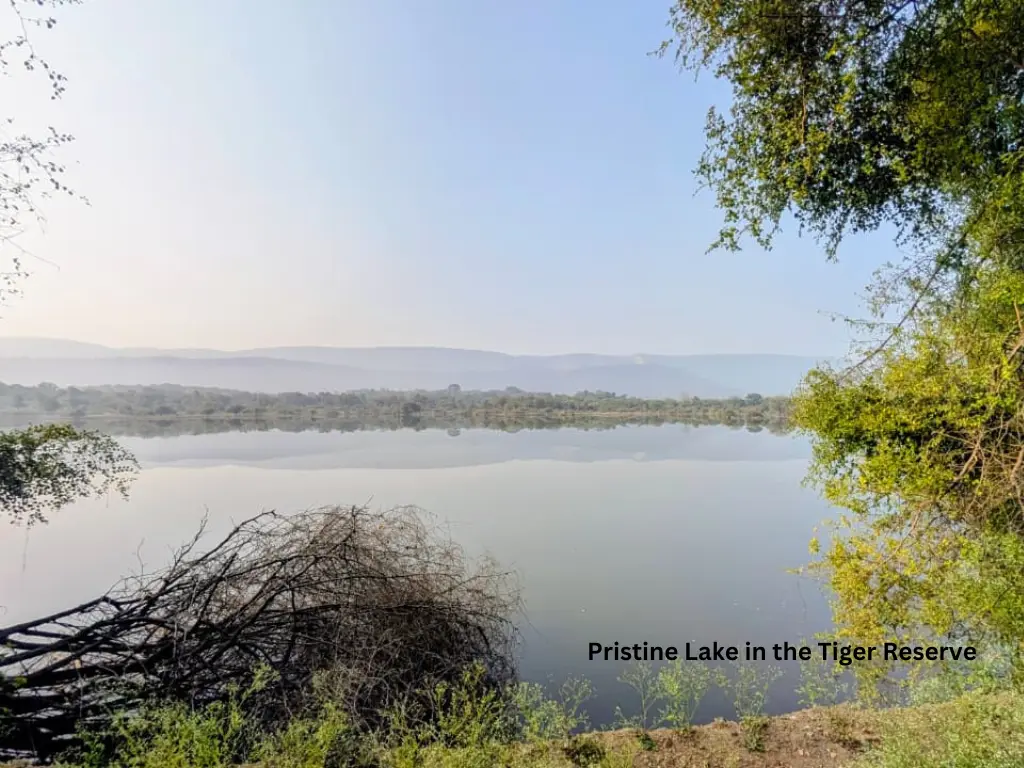
- The terrain — hilly Aravallis, dry deciduous forest, rocky valleys — gives a different vibe compared to jungle-flat reserves: more dramatic landscapes, rock formations, plateaus, and diverse flora & fauna.
- For a short weekend trip, Sariska gives a satisfying “wild escape” — safari, nature, peace — without needing a week-long commitment.
Sariska vs Ranthambore — which to pick?
- Ranthambore: Larger tourist infrastructure, flatter/open terrain (ruined forts & waterbodies), historically higher chances of tiger sightings, busier and more commercial.
- Sariska: Hilly Aravalli terrain, rockier/drier deciduous forest, fewer crowds, more “wild” feel — ideal for those who want quieter safaris and a weekend escape from NCR.
Pick Ranthambore if your priority is the absolute highest chance of a tiger sighting and multiple safari options. Pick Sariska if you want accessibility from Delhi, fewer crowds, and a rugged landscape. (Both are excellent; choice depends on experience you want.)
| Feature | Sariska | Ranthambore |
|---|---|---|
| Distance from Delhi | Closer | Farther |
| Crowds | Much fewer | Very crowded |
| Sightings | Good but not guaranteed | Higher chances |
| Terrain | Rocky, hilly Aravallis | Open plains, lakes, ruins |
| Vibe | Raw, peaceful jungle | Touristy, commercial |
✅ Final Thoughts & Practical Tips
- 🕗 Best to book early — seats fill quickly, especially for sharing-jeep or canter safaris.
- 🎒 Stay near the reserve or close to entry gates — gives flexibility, saves time, easier early-morning safari.
- 📅 Check safari shift timings and park holidays .
- 👟 Bring neutral-coloured clothes, good shoes, water, binoculars / camera — wildlife is unpredictable; comfort and stealth help.
- 🎯 Focus on core-zones (Zone 1 or Zone 3) for best chance of tiger / big-wildlife sightings.
- 🌳 Even if tiger’s elusive — enjoy the rich flora, birds, deer, forest vibe & sunrise/sunset in hills.
🏛 Extended Trip Ideas — Explore Alwar
If you have an extra day in hand, plan a quick detour to Alwar, just 40 km from Sariska. Start with the majestic Bala Qila (Alwar Fort) for panoramic city views, followed by the serene Siliserh Lake Palace, perfect for boating and golden-hour photos. Don’t miss the beautifully carved Moosi Maharani Ki Chhatri, and the historic City Palace, which houses rare manuscripts and royal artefacts. Alwar is a treat for history buffs, architecture lovers, and anyone who enjoys slow-paced cultural exploration. You can find all the details here.
✨ Conclusion
Sariska Tiger Reserve is one of Rajasthan’s most underrated wildlife destinations — offering rich history, diverse wildlife, peaceful forests, and easy accessibility from Delhi and Jaipur. Whether you’re here for tiger sightings, birdwatching, a family trip, or a short getaway, Sariska delivers an experience that’s thrilling yet relaxed. With great safari zones, affordable stays, and the option to explore Alwar nearby, it’s a perfect weekend adventure. Pack your camera, book your safari in advance, and let Sariska surprise you.
FAQs
1. Where is Sariska Tiger Reserve located?
Sariska is in Alwar district, Rajasthan, around 200 km from Delhi and 170 km from Gurgaon, making it a perfect weekend getaway.
2. Which safari zone is best in Sariska?
Zone 1 and Zone 3 offer the highest chances of tiger sightings but not guranteed. Zone 2 is average, and Zone 4 (buffer) is usually not recommended for tigers; however the big cats can surprise you anywhere.
3. What is the best time to visit Sariska?
Visit between November and April for pleasant weather and better wildlife visibility.
4. How many tigers are there in Sariska?
Sariska has around 50 tigers spread across roughly 800 sq. km, according to recent forest estimates.
5. How to book a Sariska safari online?
Book through the Rajasthan Government’s online portal. Choose your zone, timing, and vehicle type in advance.
6. What animals can you spot in Sariska?
Expect tigers, spotted deer, sambar, nilgai, peacocks, crocodiles, and many bird species.
7. How much does a safari cost in Sariska?
A jeep safari usually ranges between ₹ 1300- 1400 per person, depending on weekday/weekend pricing.
8. Is Sariska better than Ranthambore?
Sariska is less crowded, more peaceful, and great for serious wildlife lovers. Ranthambore has higher tiger density but also more tourists.


Leave a reply